
7 Ecommerce Marketing Automation Workflows That Turn Browsers Into Buyers
1st Jul 2026
8 Minutes Read
By Atul Verma
Quick Answer
Ecommerce marketing automation enables online businesses to automate repetitive marketing tasks such as welcome emails, abandoned cart reminders, product recommendations, post-purchase follow-ups, and customer retention campaigns. Instead of relying on manual communication, automation tools trigger personalized interactions based on customer behavior, helping businesses increase conversions, improve customer experiences, and boost repeat purchases. Whether you're running a Shopify store or managing an enterprise ecommerce platform, implementing the right automation workflows can significantly improve marketing efficiency and revenue.
Key Takeaways
Automate customer interactions to save time and improve consistency.
Deploy automated workflows to recover 5–15% of abandoned carts.
Personalize the ecommerce customer journey using behavioral data.
Increase average order value with product recommendation workflows.
Improve customer retention through loyalty and win-back campaigns.
Combine email and SMS marketing automation for higher engagement.
Introduction
Getting traffic to your ecommerce store is only half the battle. The real challenge is converting visitors into paying customers and keeping them engaged long after their first purchase. With rising customer acquisition costs and increasing competition, manually managing every interaction is no longer practical.
According to Ominsend Automated ecommerce emails convert at 1.49% versus 0.08% for batch campaigns and generate roughly 22 times more revenue per send, underscoring why automation is essential for scalable growth.
This is where ecommerce marketing automation becomes essential.
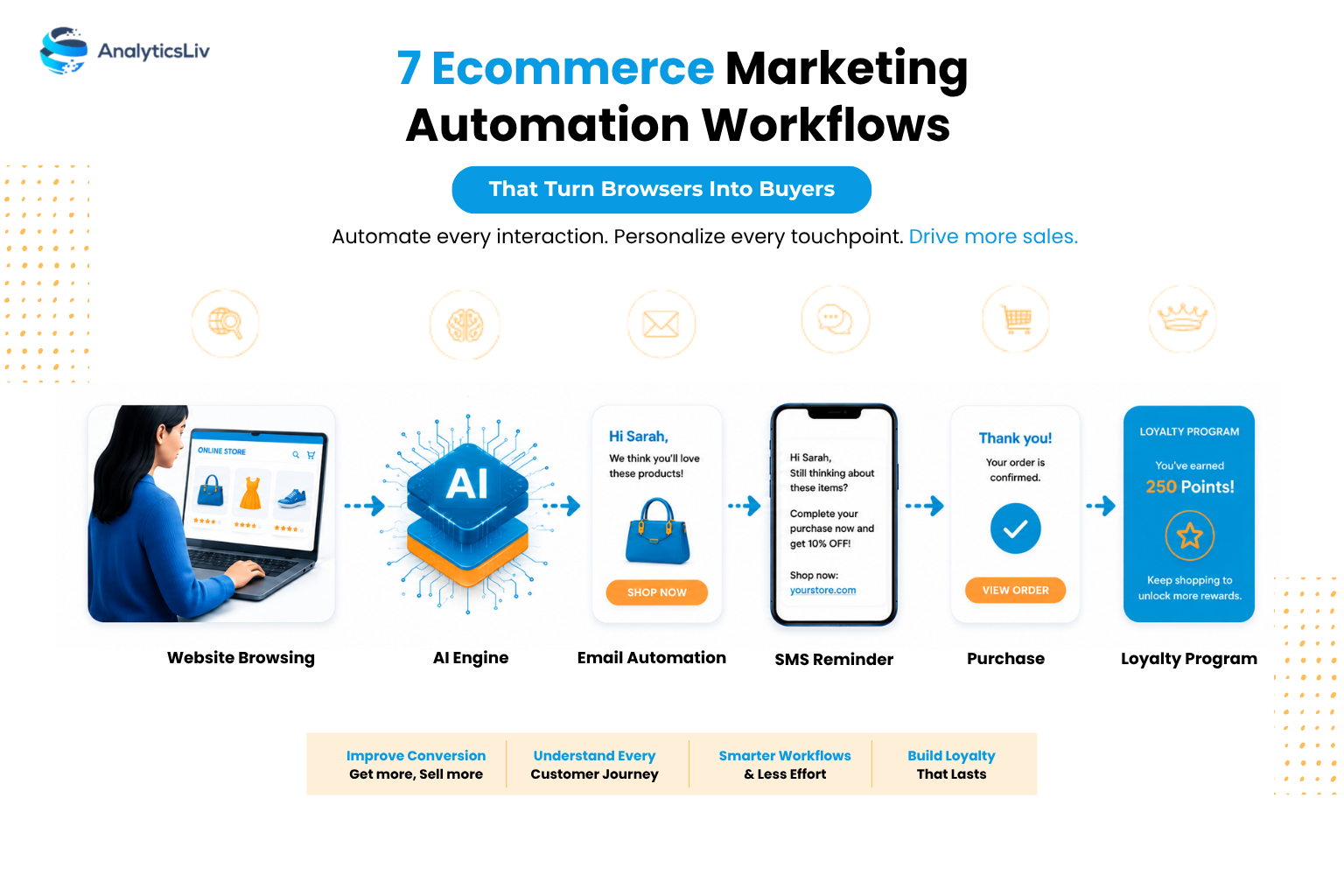
By automating key touchpoints throughout the customer journey, businesses can deliver personalized experiences at the right time without increasing manual effort. From welcoming new subscribers and recovering abandoned carts to sending product recommendations and rewarding loyal customers, automation ensures that every interaction contributes to higher conversions and stronger customer relationships.
In this guide, we'll explore seven proven ecommerce marketing automation workflows that help businesses streamline marketing operations, improve customer experiences, and drive sustainable growth.
Customer Journey Overview

What Is Ecommerce Marketing Automation?
Ecommerce marketing automation uses software to automatically trigger personalized marketing actions based on customer behavior, data signals, and predefined rules — without requiring manual input for each interaction. Instead of batch-and-blast campaigns, automation delivers the right message to the right person at the right time.
Every ecommerce automation workflow consists of three components:
Trigger: A customer action that starts the workflow (e.g., abandoning a cart, completing a purchase, signing up).
Condition: Rules that filter which customers receive which messages (e.g., hasn't purchased in 30 days).
Action: The automated response — an email, SMS, loyalty point award, or product recommendation.
While traditional marketing requires you to manually broadcast to a crowd, e-commerce automation builds a system that automatically holds thousands of highly relevant, one-on-one conversations with your customers simultaneously.
Why Ecommerce Marketing Automation Matters
Modern customers expect timely, personalized communication across multiple channels. Marketing Automation helps businesses meet these expectations while reducing repetitive tasks for marketing teams.
Benefits
Higher conversion rates through personalized messaging.
Improved customer retention with automated follow-ups.
Increased average order value through cross-selling and upselling.
Better customer experience with consistent communication.
Reduced manual workload for marketing teams.
Workflow 1: Welcome Email Series - Convert New Subscribers Immediately
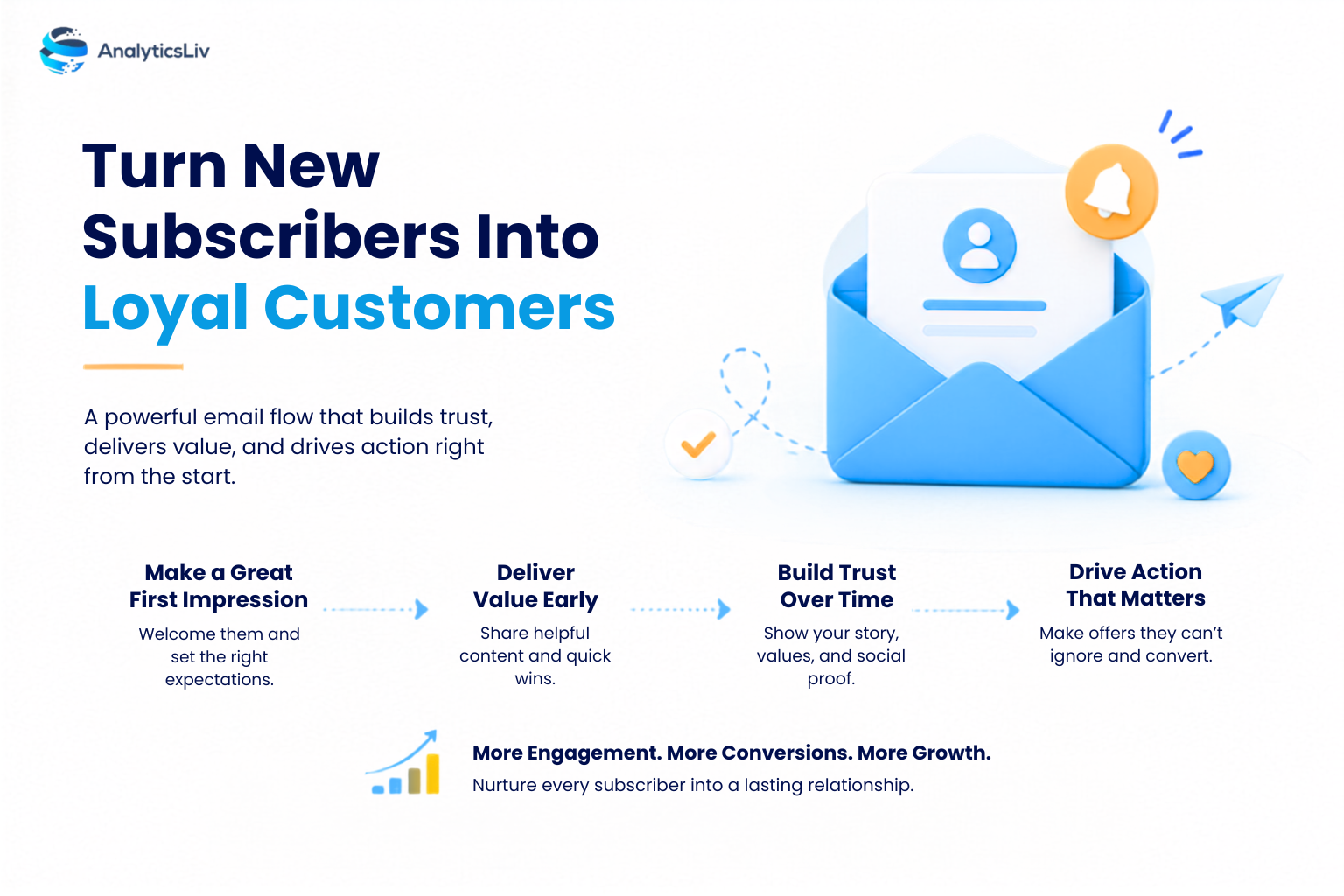
When a customer signs up for your newsletter or creates an account, trigger a welcome sequence that introduces your brand, highlights best-selling products, and encourages the first purchase with an exclusive offer.
Best Practice: Personalize each email with the subscriber's first name and dynamically populate product blocks based on browsing history. A/B test subject lines across the first 500 sends before scaling.
Common Mistake: Sending a single generic welcome email and dropping subscribers into a standard promotional calendar, wasting the highest-engagement window in the customer lifecycle.
Workflow 2: Abandoned Cart Recovery - Recapture Lost Revenue
High shopping cart abandonment is one of the biggest revenue leaks for e-commerce brands. An automated recovery workflow acts as a safety net, systematically engaging hesitant shoppers with multi-channel reminders that nudges them back to checkout to complete their purchase.
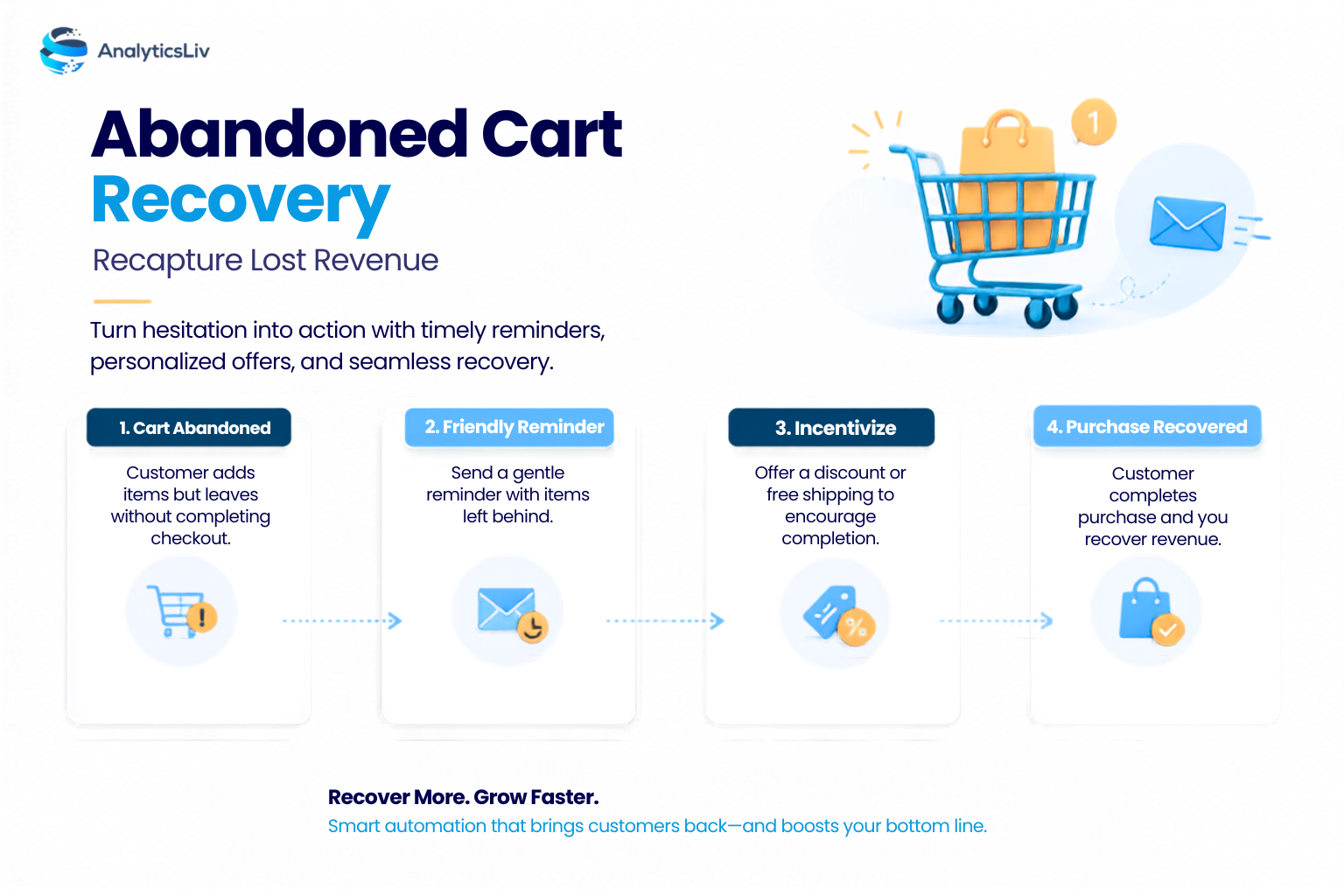
Best Practice: By deploying your first reminder within the golden 1-hour window and following up precisely 24 hours later, you capture the shopper when their intent is highest—saving your discounts only for the final push so you don't unnecessarily sacrifice profit margins.
Common Mistake: Assuming the only reason a customer abandoned their cart was price, completely ignoring issues like unexpected shipping fees, technical glitches, or unanswered product questions.
Workflow 3: Personalized Product Recommendations - Increase Average Order Value
Ecommerce personalization starts in the inbox. By using customer purchase and browsing data to drive email content, you can automatically send the right product to the right person at the right time, increasing average order value without any manual campaign creation.
Examples:
Frequently Bought Together
Recently Viewed Products
Similar Products
Customers Also Purchased
Best Practice: Use dynamic product blocks in every recommendation email so content auto-populates based on each recipient's individual data — ensuring every customer receives a uniquely relevant email without manual content production per send.
Common Mistake: Sending the same "You might also like" email to your entire list based on bestsellers rather than individual behavior. Blanket product emails feel generic, erode trust, and convert far lower than behavior-triggered recommendation flows.
Workflow 4: Post-Purchase Follow-Up - Build Relationships That Drive Repeat Purchases
The post-purchase period is the most underutilized stage of the ecommerce email automation journey. Most brands stop communicating the moment a payment is confirmed. A structured post-purchase email sequence keeps customers engaged through fulfillment and beyond, turning one-time buyers into repeat customers.
Example:
Order confirmation
Shipping updates
Product usage tips
Review requests
Cross-sell recommendations
Best Practice: Space each email purposefully so the sequence feels helpful rather than intrusive. Every email should deliver genuine value like information, reassurance, or a relevant offer, not just promotional noise.
Common Mistake: Sending only a transactional order confirmation and going silent until the next promotional campaign. This missed window is where customer relationships are built or lost.
Workflow 5: Customer Win-Back Campaign
Not every customer who stops purchasing is gone forever. A win-back email campaign automatically identifies customers who were once active but have gone quiet and re-engages them with personalized content before they churn permanently. Customer retention automation is significantly cheaper than acquiring new customers from scratch.
Example:
Inactivity Trigger Email
Incentive Email
Final Re-engagement Email
Cool-Down: Unresponsive customers exit the workflow into a 30-day pause to prevent list fatigue and protect email deliverability.
Goal: Increase customer retention and reactivate dormant buyers.
Best Practice: Segment your win-back flow by customer value. High-spend customers who have lapsed deserve a more personalized email with a stronger incentive, treat them differently from one-time low-value buyers.
Common Mistake: Sending a generic discount to every inactive customer from Day 1. This trains customers to ignore regular emails and wait for a re-engagement offer, eroding your margins over time.
Workflow 6: Loyalty Rewards Automation
Loyalty programs deliver results only when they run consistently. Automated loyalty email workflows ensure every qualifying customer is recognized and rewarded without manual tracking, creating a self-reinforcing cycle of repeat purchases and long-term brand advocacy.
Loyalty points
Birthday offers
VIP discounts
Early access to new products
These campaigns help build long-term customer loyalty.
Best Practice: Keep loyalty emails focused on progress and reward. Show customers exactly how close they are to the next tier or redemption milestone. Progress visibility is one of the strongest behavioral motivators in loyalty email design.
Common Mistake: Enrolling customers in a loyalty program but rarely communicating their status or points balance. Loyalty programs fail silently when customers forget they're members.
Workflow 7: SMS Marketing Automation
SMS complements your email automation strategy by providing a direct, immediate channel for messages that require urgency. While email is built for content-rich nurture sequences, SMS excels at short, time-sensitive communication that demands attention within minutes of sending. Used sparingly and purposefully, it significantly amplifies the impact of your broader ecommerce automation workflow.
Flash sales
Order confirmations
Limited-time discount codes
SMS automation complements email by providing immediate engagement.
Best Practice: Limit SMS sent to 2–4 per month per customer. Every message must be immediately relevant and actionable. SMS is a high-trust channel that gets permanently switched off the moment it feels like spam.
Common Mistake: Mirroring your full email content calendar into SMS. SMS is not a replacement for email. It is a high-attention amplifier for moments where timing and brevity matter most.
Ecommerce Automation Workflow Comparison
Choosing the right channel for each automation workflow ensures your messages land where they have the highest impact across various customer touchpoints. The table below compares core e-commerce workflows, their primary objectives, and their most effective deployment channels.
Workflow
Primary Goal
Recommended Channel
Welcome Series
Convert new subscribers
Abandoned Cart
Recover lost sales
Email + SMS
Product Recommendations
Increase AOV
Website + Email
Post-Purchase
Improve customer satisfaction
Win-Back Campaign
Reactivate inactive customers
Loyalty Program
Increase retention
Email + SMS
SMS Automation
Instant communication
SMS
Recommended Ecommerce Automation Tools
Selecting the right platform is critical for executing your marketing strategy and seamlessly managing customer touchpoints at scale. The table below outlines the industry's leading e-commerce marketing automation tools and their primary strengths.
Tool
Best For
Klaviyo
Email & SMS Automation
HubSpot
CRM and Marketing Automation
Omnisend
Omnichannel Marketing
ActiveCampaign
Customer Journey Automation
Mailchimp
Small Ecommerce Stores
Best Practices
Executing a successful automation strategy requires shifting from a static setup to a dynamic, data-driven framework. Adhering to these industry-wide best practices ensures your automated workflows consistently deliver high performance across all customer touchpoints.
Segment customers based on behavior.
Personalize every automated message.
Test subject lines and CTAs regularly.
Monitor key metrics such as open rates, click-through rates, and conversions.
Continuously optimize workflows using performance data.
Automation handles the execution, but your data must dictate the strategy; constantly testing and refining your workflows is what prevents automated messaging from becoming irrelevant spam.
Frequently Asked Questions
What is ecommerce marketing automation?
Ecommerce marketing automation uses software to automate customer communication based on behaviors such as browsing products, abandoning carts, or completing purchases.
Which workflow provides the highest ROI?
Abandoned cart recovery often delivers the highest return because it targets customers who have already shown purchase intent.
Is marketing automation suitable for small businesses?
Yes. Start with the welcome series and abandoned cart recovery — both deliver results with small list sizes and need no historical data. Add win-back and loyalty workflows once you have at least 6 months of purchase history to segment against.
What metrics should I track for each automation workflow?
Track four metrics: open rate, click-through rate, conversion rate, and revenue per recipient. Focus on conversion rate and revenue per recipient — open rates tell you who read the email, not who bought.
How often should I update my automation workflows?
Review every active workflow quarterly. Refresh product blocks, test new subject lines, and revisit segmentation rules. Workflows built 12 months ago may no longer reflect your current catalog or customer behavior.
How long does it take to see results from ecommerce email automation?
Abandoned cart recovery and welcome series workflows typically show measurable results within the first 2–4 weeks of going live. Win-back and loyalty workflows take longer — expect 60–90 days before you have enough data to evaluate performance accurately.
Conclusion
Ecommerce marketing automation is no longer optional for businesses looking to scale efficiently. By implementing workflows such as welcome emails, abandoned cart recovery, product recommendations, post-purchase follow-ups, loyalty rewards, and SMS campaigns, businesses can create personalized customer experiences while reducing manual effort.
Whether you're launching a new online store or optimizing an established ecommerce brand, these seven workflows provide a practical framework for improving conversions, increasing customer retention, and driving sustainable growth.
Call to Action
Looking to implement scalable ecommerce marketing automation? Contact AnalyticsLiv Team, helping businesses design data-driven automation workflows that integrate email, SMS, CRM, and analytics platforms to deliver personalized customer journeys and measurable business results.
Author Bio
Atul Verma is a Senior AI Automation Engineer at AnalyticsLiv, specializing in AI-powered workflow automation, ecommerce automation, API integrations, marketing technology, and customer journey optimization. He helps businesses build scalable automation systems that improve operational efficiency, enhance customer experiences, and drive measurable growth through modern AI and automation technologies.