In short
Meta ads now revolve around Reels and AI-assisted creative. Attention has moved to short vertical video, and Advantage+ can generate and test creative variations at scale. The practical result: creative fatigue, not targeting, is the usual scaling limit. Plan vertical-first creative, produce more variations, and let the algorithm learn from them.
Contents5 sections
Over the last two years something has shifted inside Meta's ad system. It didn't come with a big algorithm announcement. It happened gradually, in placements, in creative workflows and in how delivery now rewards advertisers who produce and test creative faster.
Reels is no longer an emerging format. It is the centre of gravity on Instagram.
Sensor Tower data reported in 2025 put Reels at more than half of Instagram ads, up from roughly 35% a year earlier, and at about 46% of time spent in the Instagram app in the US. Treat these as third-party estimates rather than official Meta figures, but the direction is clear.
At the same time, Meta has built generative AI into its Advantage+ suite: automated branding, creative enhancements, video highlight extraction and AI-generated video variations. Meta itself has cited ROAS lifts of around 22% for advertisers using these AI features. That is Meta's own figure, and results vary by account.
Put together, attention has consolidated around short vertical video, and AI has shortened creative production. That combination changes how performance campaigns on Meta should be run.
Why does Reels change Meta ad strategy?
For years many advertisers ran Meta Ads Manager around audience structures: lookalikes, interests, exclusions and layered targeting. Creative mattered, but targeting felt like the main lever.
That has flipped. When nearly half of time on Instagram goes to Reels, Reels ads are no longer an extension of your feed strategy. They are the strategy.
Reels is full-screen, vertical and algorithmically sequenced. It rewards motion that stops the scroll and punishes static assets that were simply resized from feed. If your ad looks like a cropped feed post, the auction tells you quickly.
Budget should follow attention. But moving spend from feed to Reels is only half of it. The real constraint for most performance teams is not media buying skill. It is creative throughput.
Why is creative fatigue the real scaling limit?
Most scaling problems on Meta today are not targeting failures. They are creative fatigue that looks like a performance decline.
Short-form video makes this worse:
- The format that drives engagement also shortens an ad's lifespan.
- Hooks burn out faster.
- Trends change weekly.
- People scroll past anything familiar.
An account spending a meaningful monthly budget on only three video variations will run out of fresh creative quickly.
This is where generative AI becomes practical. Inside Advantage+, Meta offers:
- Automated branding overlays
- Dynamic text adaptations
- Video generation that turns static images into motion assets
- Highlight extraction from longer videos
- Automatic testing of creative combinations
Many marketers treat these as convenience tools. The bigger change is that AI shortens the gap between an idea and a live ad. Instead of waiting on design cycles, brands can produce variations at scale. Instead of debating which hook will work, they can launch several AI-assisted intros and let delivery data decide.
How does AI creative help the algorithm learn?
Meta's delivery system has always rewarded more signal: more variations, faster learning and stronger conversion feedback.
AI-generated creative inside Ads Manager speeds up iteration. With ten creative angles instead of three, the system has more to test and refines delivery faster. That affects CPM efficiency, audience expansion and placement optimisation across Reels and other placements.
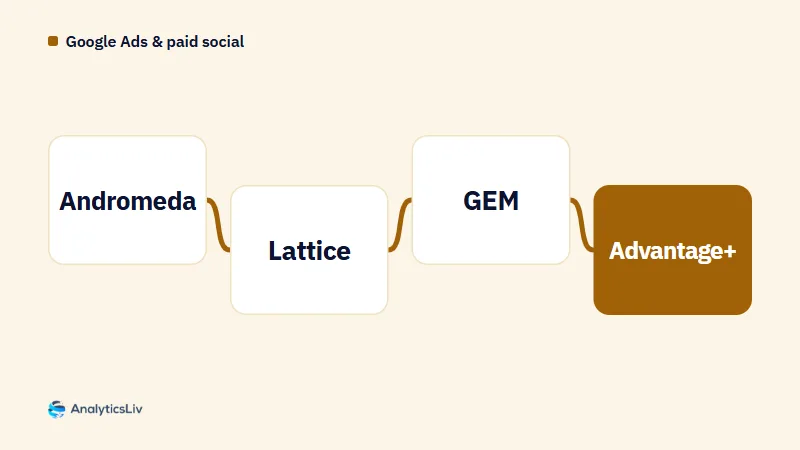
The effect compounds: more creative, more performance data, faster learning, smarter delivery and, usually, better ROAS. Whether your account sees a small or a large lift matters less than the direction. For how Meta's models choose and rank ads, see Meta Andromeda, Lattice and GEM explained.
Advertisers who treat AI as a co-pilot for variation, not a replacement for strategy, will outpace those who rely on a few handcrafted ads. The edge is no longer targeting alone. It is creative volume matched to algorithmic personalisation.
How should you reallocate budget to Reels?
If over half of Instagram ads already run in Reels, holding back is not cautious. It is out of step with where attention is.
Plan creative vertical-first. Treat feed as a placement you adapt to, not the place creative starts.
That doesn't mean moving most of your spend to Reels overnight. It means aligning production, testing cadence and measurement with where attention and delivery advantages are growing.
Teams that build Reels-native production into their workflow, and add AI-assisted variations to weekly tests, will scale with fewer bottlenecks. Teams that don't often see "mysterious" performance swings that are really under-production rather than algorithm instability.
What will matter next for Meta advertisers?
Three trends are likely to grow stronger:
- AI-assisted creative production will become standard. The question will move from "Should we use it?" to "How well are we directing it?"
- Creative strategy will separate strong teams from average ones. As automation grows, the difference moves upstream into messaging angles, positioning and hooks.
- Treating Meta as one system will matter more. Reels, Advantage+ and the AI creative tools are connected layers of the same delivery system, not separate channels.
The future of Meta advertising is not about chasing every new feature. It is about noticing structural shifts early. Reels has consolidated attention and generative AI has shortened creative production. If you still think only in terms of placements and targeting, you are solving last year's problem. If you want help restructuring Meta campaigns around this, see our performance marketing service.